
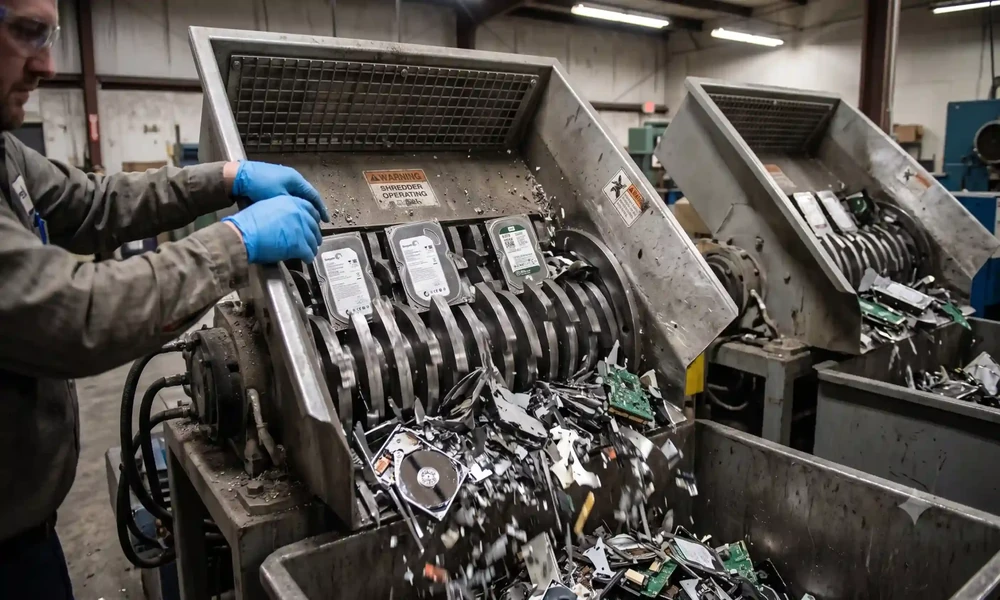

Discussions about data security tend to focus entirely on hard drives, leaving USB sticks, backup tapes, old mobile devices and printer memory largely unaddressed even though each can hold just as much recoverable data as a full-sized drive. Understanding why media destruction services need to cover this full range of media, not hard drives alone, closes a gap many businesses do not realise exists until it becomes a genuine, costly problem.
Media Beyond Hard Drives That Also Need Destruction
USB drives, memory cards, backup tapes, mobile device storage and even printer and photocopier internal memory can all retain recoverable data, and a disposal process focused only on desktop and server drives leaves these other sources unaddressed entirely, often without anyone in the business realising they were ever a factor worth considering in the first place. A photocopier retired after years of scanning confidential documents is a particularly overlooked example, since few staff think of it as a data-holding device at all.
What Happens If Media Is Simply Discarded
Media placed in general waste or sold second-hand without proper sanitisation can end up in the hands of anyone willing to look, and recovery of meaningful data from improperly discarded media is neither rare nor particularly difficult with freely available tools that require no special technical skill to use effectively. A second-hand marketplace listing for a used device is sometimes all it takes for improperly wiped media to end up in the wrong hands entirely by accident, with no way to trace where it eventually went.
Regulatory Exposure From Improper Disposal
A business that cannot demonstrate proper handling of media containing personal or regulated data faces genuine regulatory exposure if a breach is later traced back to improperly discarded equipment, regardless of how the original data loss actually occurred or how small the discarded device seemed at the time it was thrown out. Regulators generally care less about the size of the device than about whether the business had a documented process governing its disposal at all.
Reputational Risk of a Data Leak
A data leak traced to carelessly discarded media damages client and partner trust in a way that is considerably harder to repair than the direct cost of the incident itself, particularly for a business whose relationships depend on handling sensitive information responsibly and consistently across every device it retires, not just the ones that obviously look important.
How Destruction Differs by Media Type
Solid-state media, magnetic tape and optical media each require slightly different destruction approaches to genuinely render data unrecoverable, since a method effective on a spinning hard drive does not necessarily work the same way on flash-based storage or older tape formats. Comparing this against it asset recycling companies clarifies why a one-size approach to destruction does not actually cover every media type properly regardless of what a provider might claim.
Verifying a Provider’s Destruction Method
Asking a provider specifically how they handle each media type, rather than accepting a general assurance that all media is destroyed properly, reveals whether the process is genuinely tailored or applied uniformly regardless of what is actually being destroyed on any given collection day. A provider unable to answer this in specific terms is likely applying a single generic process to everything that comes through the door.
Chain of Custody From Collection to Destruction
Media in transit between collection and final destruction represents a window of genuine risk, and a documented, secure chain of custody during this window matters as much as the destruction method itself in protecting against loss or interception before the material even reaches the destruction facility at all. This is worth asking about explicitly rather than assuming transport security is simply handled somewhere along the way without any real oversight.
Cost Versus Risk When Comparing Providers
A cheaper provider cutting corners on documentation or secure transport is not actually cheaper once the cost of a potential breach is factored in, making cost comparison genuinely misleading without also comparing the security of the full process each provider actually follows from start to finish. A modest saving on the collection fee rarely offsets even a fraction of what a genuine data breach ends up costing a business once every downstream consequence is properly counted.
Why a Certificate Alone Isn’t Enough Proof
A certificate stating media was destroyed is only as reliable as the actual process behind it, and a business should understand what that process actually involved rather than treating the certificate itself as sufficient assurance on its own. Confirming certified it asset disposition itad solutions gives considerably more genuine confidence than the certificate document alone ever could provide by itself.
Making Media Destruction Routine, Not Reactive
Building a routine schedule for destroying all forms of retired media, not just hard drives, closes the gap most businesses only discover once a specific device is already lost, stolen, or sold without proper handling, well after the point where anything could actually be done about it or the damage genuinely undone.